
Table Of Contents
Duro-Last Roofing Explained: A Complete Guide For Arizona Owners
Owning a commercial building in the Phoenix Valley means accepting one hard truth. The climate is actively trying to destroy your roof.
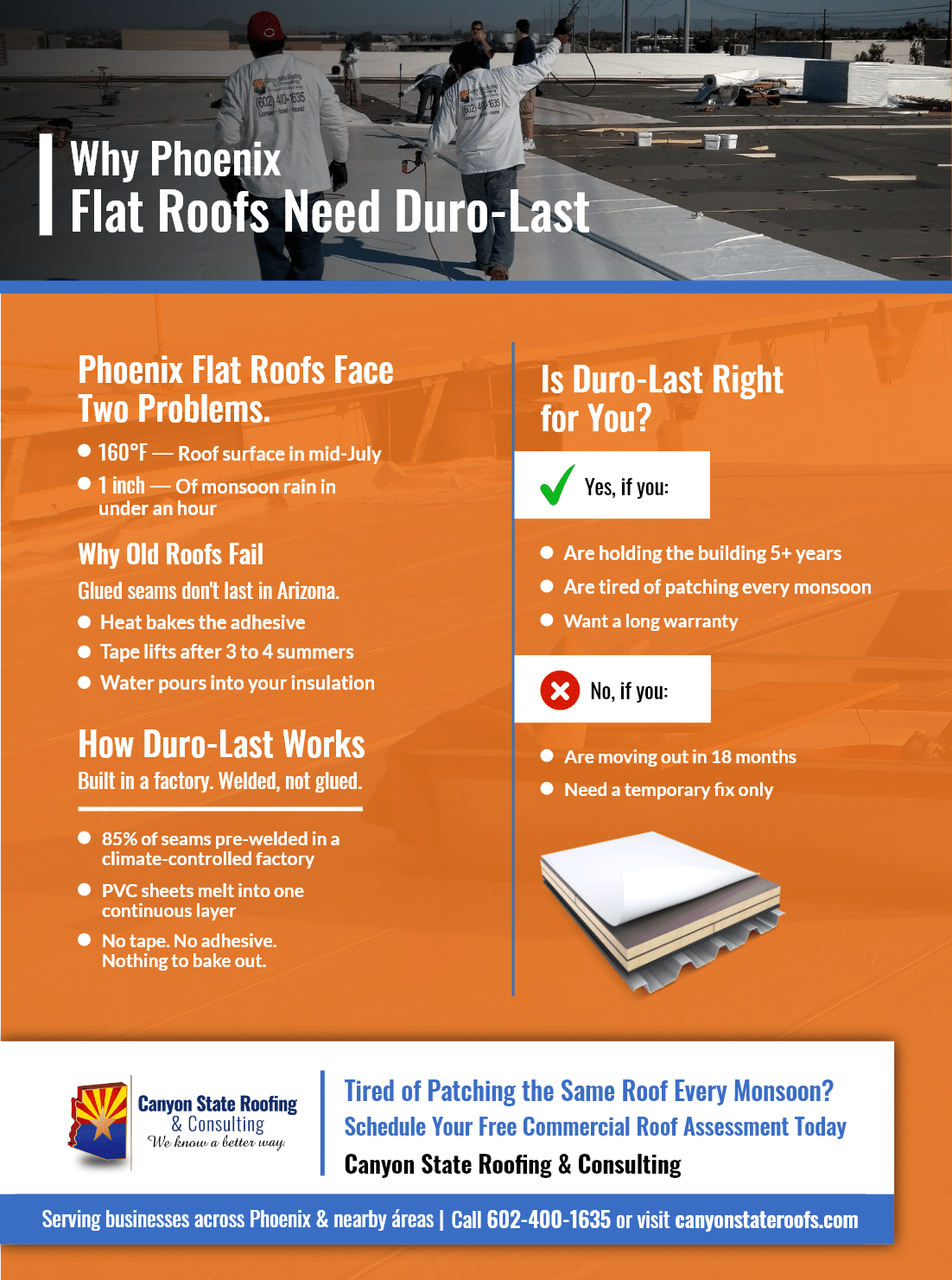
By mid-July, surface temperatures on a standard dark flat roof push past 160 degrees. The roofing materials bake. Your HVAC system runs non-stop just to keep the building livable. Then the monsoons hit. An inch of rain can dump in under an hour, and every weak seam and dried-out patch of sealant on that baked roof gets exposed at once.
If you’re managing a commercial property, an industrial warehouse, or a multi-family complex in Arizona, a roof that just checks a box won’t survive here. You need a system built for thermal shock and heavy water loads.
Our owner Jim McLain has been roofing in Arizona since 1982. Over more than four decades of repairing and replacing commercial roofs across the Valley, our team has figured out what actually holds up in the desert and what doesn’t. This guide walks you through the Duro-Last roofing system, what it costs, and where it makes sense.
The Anatomy of a Duro-Last Roof: What Exactly Is It?
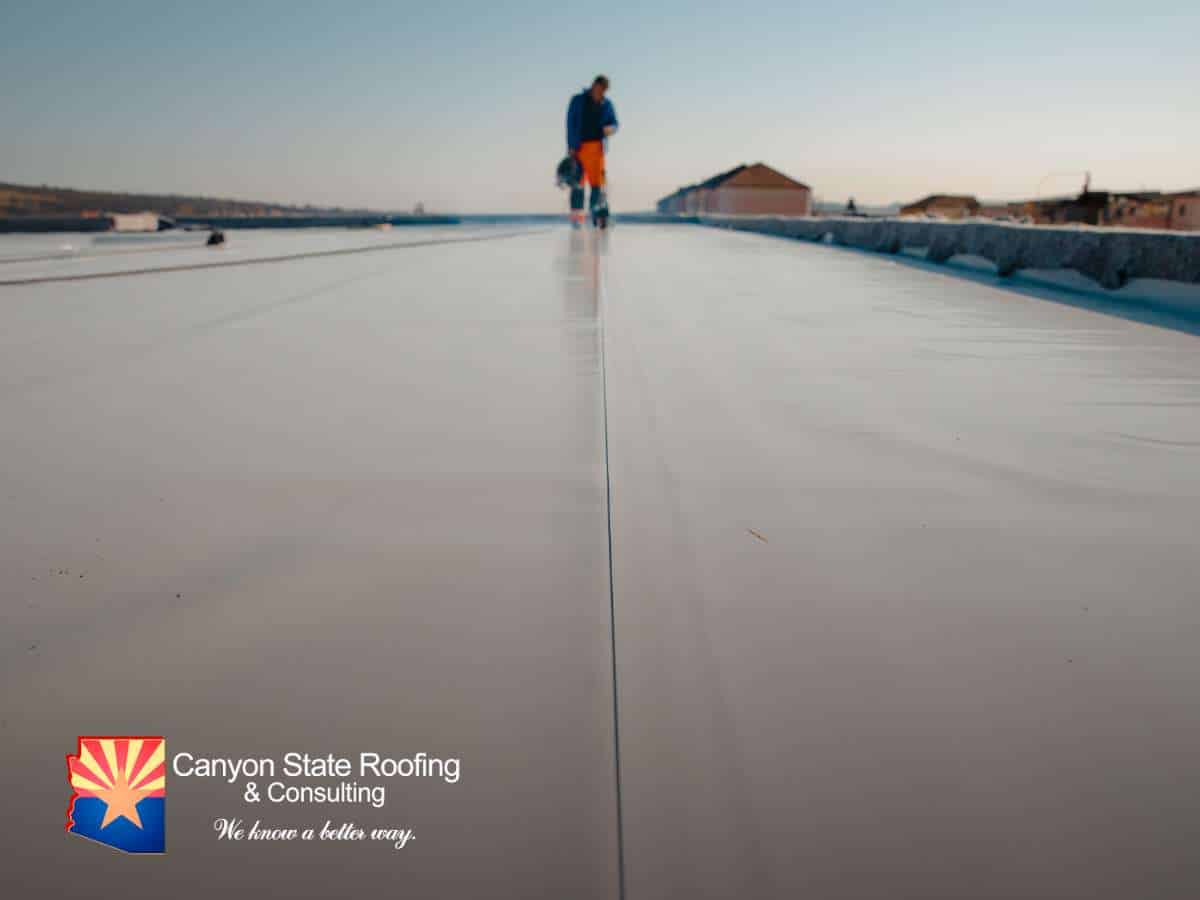
Duro-Last is a single-ply thermoplastic PVC (polyvinyl chloride) membrane. But to understand why it performs the way it does, we have to look at how it’s built.
A commercial roof isn’t just a sheet of plastic. The strength of a Duro-Last membrane comes from its weft-inserted anti-wicking polyester scrim, a woven grid of polyester threads buried inside the PVC. The grid is what gives the membrane its puncture resistance and dimensional stability. When an HVAC tech drops a wrench on the roof, the scrim is what stops the membrane from tearing through.
The Custom-Fabricated Advantage
The biggest difference between Duro-Last and almost every other flat roof on the market is where the roof is put together.
With traditional flat roofs, contractors bring raw rolls of material to your building. Their crews spend weeks on their hands and knees in 110-degree heat, welding or gluing hundreds of seams together by hand. Human error is inevitable under those conditions.
Duro-Last changes the equation. Up to 85% of the seams in a Duro-Last roof are pre-welded in a climate-controlled factory before the system ever reaches your building.
We measure your building’s exact dimensions, including every AC unit, skylight, and drain, and send those specs to the factory. They build the roof to your specs.
When we show up to install, we’re laying down massive pre-welded sheets. Fewer field seams means fewer opportunities for human error and a much lower risk of leaks.
The Science of Desert Roofing: Why Standard Roofs Fail in Arizona
To understand why property managers upgrade to Duro-Last, you need to know why the old systems fail.
1. Thermal Shock and Adhesives
Phoenix afternoons hit 115 degrees. Nights can drop 30 degrees from there. Building materials expand and contract through that swing every single day. That’s thermal shock, and it’s brutal on roof seams.
Older single-ply systems like EPDM rubber and some TPO setups rely on chemical adhesives and double-sided tapes to hold their seams together. Three or four Arizona summers in, those glues bake out, dry up, and turn brittle. The tape fails. The seam lifts. The next rainstorm pushes water straight into your insulation.
Duro-Last seams aren’t glued. They’re hot-air welded, which melts the overlapping PVC sheets into one continuous layer. No tape to dry out. No adhesive to fail.
2. The Ponding Water Problem
A severe Arizona monsoon can drop over an inch of rain in under an hour. Flat commercial roofs are rarely actually flat. They settle. They develop low spots. When rain hits, water pools in those depressions, and you’ve got what we call ponding water.
Water weighs 62.4 pounds per cubic foot. If your roof is holding standing water, you’re adding thousands of pounds of dead weight to the structure, which causes the deck to sag further, which collects more water. It’s a feedback loop.
The standing water also magnifies UV exposure, which speeds up the breakdown of conventional roofing materials.
Duro-Last is built from PVC similar to what’s used in heavy-duty commercial pool liners. Combined with factory-welded seams, it handles ponding water far better than the systems it usually replaces.
The Financial Impact: Cool Roofs and Energy Savings
A stark white Duro-Last membrane is a highly rated “Cool Roof.” But what does that actually mean for your operating costs?
The Cool Roof Rating Council (CRRC) measures roofing materials based on two factors:
- Solar Reflectance: How well the roof bounces sunlight back into the atmosphere.
- Thermal Emittance: How well the roof sheds the heat that it does absorb.
A dark built-up roof soaks up solar energy and turns the top of your building into a massive radiator. That heat pushes down into your workspace, and your AC fights it all day.
A white Duro-Last membrane reflects most of that UV back into the sky. The heat never makes it past the roofline. Your HVAC units cycle less, last longer, and pull less power off the meter. On warehouses and industrial buildings with minimal ceiling insulation, the drop in summer cooling costs is significant.
When NOT to Buy Duro-Last
We operate on honest consulting. We are a reliable certified partner, which means we always tell you the truth.
Duro-Last is a premium, long-term asset. It is designed for property owners who plan to hold their building for 5, 10, or 20 years.
If you are leasing a building and moving out in 18 months, or if you just need a temporary band-aid to satisfy a buyer during a real estate transaction, a full Duro-Last system is likely the wrong financial move.
In those short-term scenarios, we might recommend a targeted repair or a silicone roof coating to buy you a few extra years. We will never push a 20-year roof on a 2-year problem.
The Real Cost of Commercial Flat Roof Replacement in Phoenix
The exact price depends on three major variables:
- The Tear-Off: Are we laying the new roof over an existing system, or do we have to pay labor and landfill fees to rip off three layers of heavy, saturated tar?
- Insulation Upgrades: Does the building code require us to add thicker rigid foam insulation (Polyiso) to increase your R-value?
- Roof Complexity: A wide-open 10,000 sq. ft. warehouse roof is fast and easy. A 5,000 sq. ft. medical office roof with 30 HVAC units, gas lines, and skylights requires intense custom detailing.
The Property Manager’s Flat Roof Maintenance Checklist
The Duro-Last membrane itself is engineered to be zero maintenance. It never needs to be recoated, resealed, or touched up over the life of the roof. That’s a real selling point, and it’s one of the reasons we keep coming back to Duro-Last for our commercial clients.
But the roof system as a whole, including drains, scuppers, pipe penetrations, and the HVAC equipment sitting on top, still benefits from a basic walkthrough twice a year. To keep your warranty fully intact and catch the small issues before they become expensive ones, we tell our clients to do a check in May before the monsoons and again in November:
- Clear the Scuppers and Drains: Wind blows leaves, dirt, and plastic bags onto the roof. If a plastic bag blocks your primary drain, water will back up. Keep the drains clear.
- Check for HVAC Damage: The number one cause of commercial roof leaks is careless service technicians. After an AC repair company services your units, check the roof to ensure they didn’t leave sharp screws behind or drag heavy metal panels across the PVC membrane.
- Inspect Pitch Pockets and Caulking: While the Duro-Last seams are welded permanently, the areas where pipes penetrate the roof (pitch pockets) rely on sealants that can degrade over time and may need occasional touching up.
The Installation Process: What to Expect
Because the Duro-Last system shows up pre-cut, our installation timeline is much shorter than what you’d see with traditional methods.
No giant kettles of boiling tar. No heavy equipment shaking the ceiling. In most cases, you can keep your business fully open while our crews work overhead.
The last step is what really sets this system apart. Because Canyon State Roofing is a Duro-Last Certified contractor, an independent Duro-Last quality assurance representative has to physically walk your roof after we finish.
If our work isn’t clean, the inspector doesn’t pass it. You don’t get a warranty until they sign off, which means the manufacturer is putting their name on our installation, not just on the membrane.
What Commercial Facility Managers Say About Our Team
We know that choosing a commercial roofing contractor is a high-stakes decision. Here is what our clients have to say about their experience working with the Canyon State Roofing team:
“My team manages 100 rental units across the Phoenix Metropolitan area and have had our share of roof issues over the years. Canyon State is professional, communicative, and responsive. The work they performed was high quality and looks phenomenal.” – Lindsay Baker [Read full review]
“These guys worked so hard, especially in the heat of July. The entire team and process was professional, and the work has been exceptional.” – Trudy Forsythe [Read full review]
Protect Your Building Before the Next Storm Hits
You shouldn’t have to cross your fingers every time the storm clouds roll over the Valley.
If you’re ready to look at a long-term solution for your commercial flat roof, Canyon State Roofing can help. Our team will inspect your building, assess your drainage, and walk you through your options. No high-pressure sales tactics, just straight answers.
Ready to upgrade your commercial property? Click Here to Request Your Complimentary Commercial Roof Consultation Today or call our office directly at: 602-400-1635 to schedule an on-site inspection

Canyon State Roofing
4809 E Thistle Landing Dr #100
Phoenix, AZ 85044
Office: 602-400-1635
Email: [email protected]
Website: www.canyonstateroofs.com