
Table Of Contents
Should I repair or replace my roof in Phoenix? Signs, Costs, and Expert Advice
It usually happens right after the first big summer monsoon. You notice a water stain blooming on your living room ceiling, or you find a handful of broken shingles sitting in your driveway.
Panic sets in. The first question is always, “Can I just patch this up?” The second is, “Do I need to buy a whole new roof?”
A quick repair is almost always the cheaper short-term fix. But patching a failing system can actually compromise your home’s structural safety, and you end up paying twice when the next leak shows up six months later.
Our team has inspected thousands of homes across the Valley over more than four decades. This guide walks you through the real signs, the honest costs, and how to decide.
The Immediate Answer: How to Decide Right Now
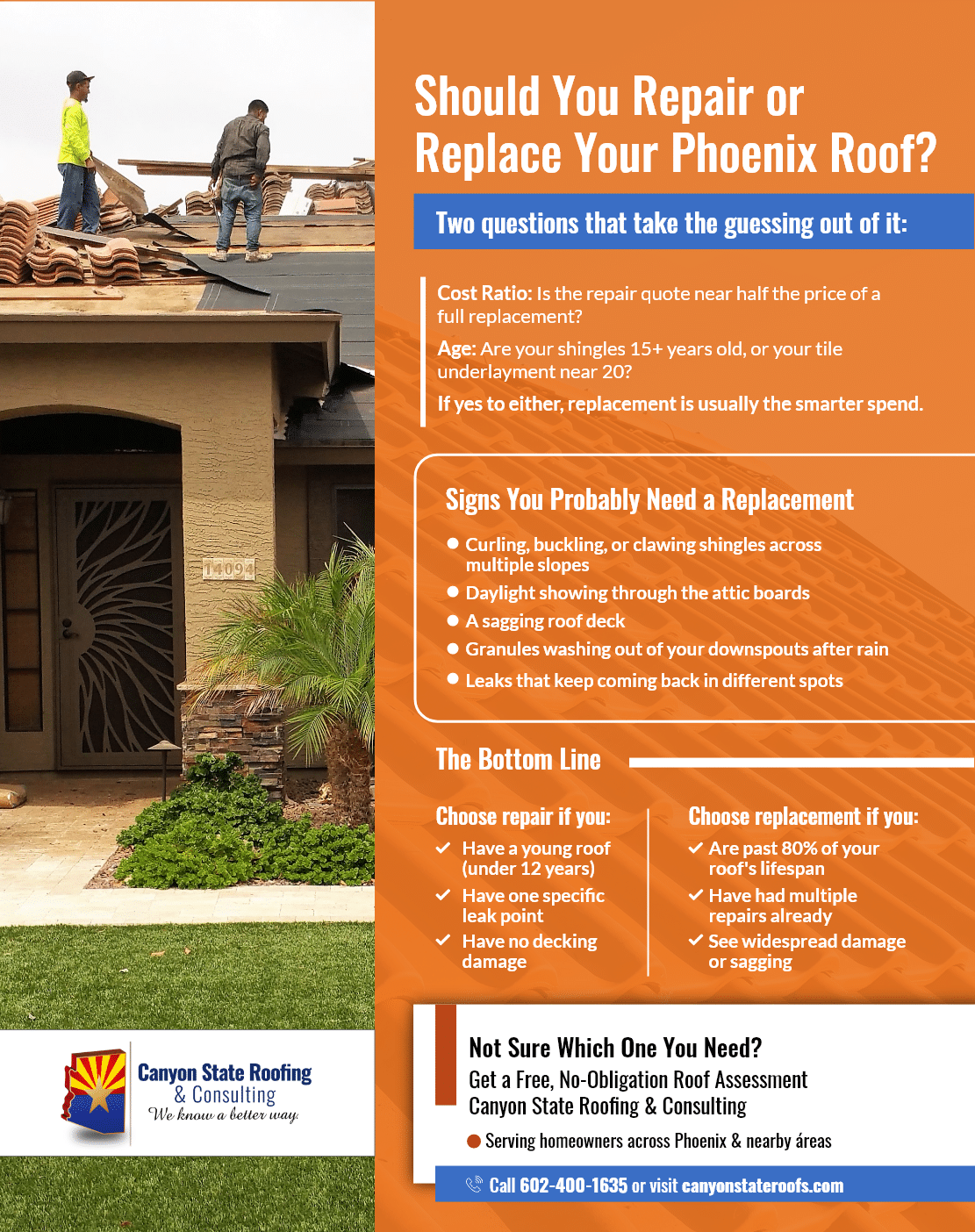
After more than four decades of inspecting Valley roofs, our team uses two practical guidelines to take most of the guessing out of this call. They’re not absolute rules, but they hold up well in the desert.
- Cost ratio: If a quoted repair lands somewhere near half the cost of a full replacement, you’re usually better off replacing. You’re paying real money to keep an aging system on life support, and the rest of the roof is going to come knocking soon enough.
- Age: If your asphalt shingles are 15 years or older in Arizona, or your tile underlayment is approaching 20 years, the surrounding materials are already brittle from UV exposure. A repair might stop today’s leak, but the next monsoon will likely find the next weak spot.
The Dangers of DIY: Don’t climb onto a 140°F Arizona roof with a hardware-store tube of caulking to patch a leak yourself. It’s dangerous, the generic sealants melt out in our summer heat, and an unauthorized repair voids your manufacturer warranty the moment a tile or shingle inspector sees it.
Repair vs. Replace: A Side-by-Side Comparison
To help you visualize the trade-offs, we’ve broken down the key differences between a targeted repair and a full system replacement.
| Feature | Roof Repair | Roof Replacement |
| Primary Goal | Localized “leak-stop” | Total structural protection |
| Average Cost | $150 – $800 (depending on the damage) | $8,500 – $22,000+ |
| Labor Time | 2 – 6 hours (depending on the project) | 1 – 3 days |
| Warranty | Typically 1-2 years (workmanship only) | 15 – 30 years (Full NDL available) |
| Energy Impact | None | Significant (Reflective materials) |
| Best For… | Slipped tiles, cracked pipe boots | Aging systems, widespread failure |
Signs You Only Need a Targeted Repair
Not every water stain requires a new roof. In many cases, a roof fails at its “penetrations”—the spots where pipes, vents, or chimneys break through the surface.
If your roof is relatively young (under 12 years) and you see missing shingles or slipped tiles in one specific area, you are likely looking at a repair. Cracked flashing around a chimney or a damaged “boot” around a plumbing vent are the most common culprits. These are considered symptoms, not systemic failures. As long as the underlying wood deck hasn’t begun to rot, a professional patch will successfully extend the life of your roof.
Signs Your Roof is Truly Failing
If you’re seeing widespread issues, your roofing system has reached the end of its functional life. Look out for:
- Curling, buckling, or clawing shingles across multiple slopes of the roof.
- Daylight showing through the attic boards.
- A sagging roof deck.
From the Field: “If you find black, sandy granules washing out of your downspouts after a rainstorm, pay attention. Those granules are the only thing protecting the asphalt from UV rays. Once they shed, the shingle is dead. It’s time for an inspection.”
Cost Breakdown: What is the Real Price?
Price is the biggest factor for most homeowners. In Arizona, we measure roofing costs by the “Square” (a 10′ x 10′ section).
- Repair costs: A standard service call for shingle replacement or tile resetting in the Phoenix metro typically runs $200 to $500. If the repair involves chimney flashing rework or hidden wood rot, expect $400 to $900.
- Replacement costs: For a typical 2,000 sq. ft. home, an asphalt shingle replacement in Arizona runs roughly $8,500 to $16,500 depending on pitch, layers being torn off, and decking condition.
- A tile “Remove and Reinstall” (R&R) on a similar home generally runs $7,000 to $15,000. We strip every tile, replace the underlayment, and re-lay the originals. The labor is heavy but the existing tiles do most of the work, which keeps the price below a full new-tile install.
Roof pitch, decking condition, the specific manufacturer warranty you’re targeting, and the layers we have to tear off all move the number. The only way to get a real price for your home is to have someone actually look at the roof.
That’s why we offer no-obligation roof assessments. Our team will walk your roof, check the underlayment, and give you an honest, detailed quote with options. Call 602-400-1635 or request your free assessment online to find out where your project actually lands.
Roof Lifespan by Material: The Arizona Reality
The national “average” lifespan of a roof is irrelevant in the Sonoran Desert. The National Roofing Contractors Association (NRCA) provides general guidelines, but our UV index forces us to adjust those expectations.
- Asphalt Shingles: National average is 25 years; Arizona reality is 15–18 years.
- Concrete/Clay Tile: The tiles last 50+ years, but the underlayment (the waterproof paper underneath) fails at 20 years.
- Duro-Last/PVC: Highly UV resistant, typically lasting 20–30 years with proper maintenance.
When Is Roof Repair No Longer Worth the Investment?
There is a psychological trap in roofing: “I’ll just patch it for $600 to get through one more year.” If you do this three years in a row on a 20-year-old roof, you’ve spent $1,800 on a roof that still needs to be replaced.
From an ROI perspective, a new roof is one of the few home improvements that significantly increases resale value. According to the Department of Energy, a reflective “cool roof” can also lower your peak cooling demand by up to 15%.
If you are repairing an old, heat-absorbing roof, you are essentially paying for high energy bills and recurring leaks simultaneously.
Why “The 20-Year Rule” Matters for Home Insurance
The Insurance Information Institute notes that insurance companies are becoming incredibly strict about roof age. If your roof hits the 20-year mark, many carriers will refuse to renew your policy, force you into a lower-tier “Actual Cash Value” policy, or mandate a replacement for continued coverage.
How to Decide: A Step-by-Step Decision Guide
- Get a real inspection: Don’t accept a quote over the phone. Our team can’t tell what’s going on under your tile or shingles without being on the roof, looking at the underlayment, and pulling core samples where the deck looks soft.
- Run the crunch test: If you can safely reach your shingles from a ladder, press on them. If they crumble under your finger, they’re past the point where a patch will hold.
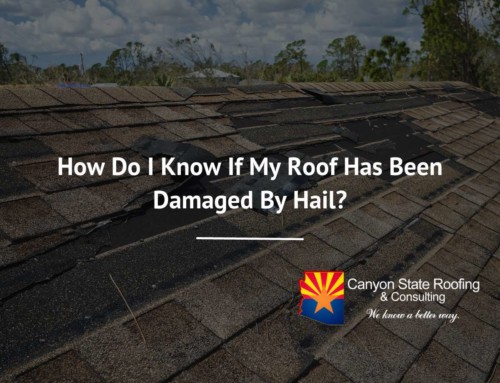
- Check your storm coverage: If you’ve had recent hail or wind damage, your homeowner’s insurance may cover a full replacement instead of a repair. We can document the damage for the claim.
- Think about how long you’re staying: Selling in two years? A new roof is one of the highest-return curb appeal moves you can make. Staying for 20? It’s worth talking through tile R&R or a high-end membrane system with a longer warranty.
Schedule Your Comprehensive Roof Assessment Today
Whether it’s a simple slipped tile or time for a full shingle replacement, your goal is peace of mind before the next storm hits.
Don’t Just Take Our Word For It: Hear From Your Neighbors
We know that calling a roofing contractor can feel like a gamble. You’re worried about high-pressure sales pitches, hidden fees for rotting wood, or contractors who disappear when a leak comes back.
At Canyon State Roofing & Consulting, we believe in radical transparency. But you don’t have to just take our word for it—here is what your Arizona neighbors have to say about our process:
“From the very start, it has been a pleasure working with Canyon State Roofing. Jim’s initial meeting was clear, focused and addressed all important aspects of the project. The follow-up quote was concise and clearly showed what will be done in three different cost scenarios, which significantly facilitated our decision process…” > – Dragan Grubisic [Read full review]
“…Overall our experience was very good. The bid was very detailed and we knew the price for additional lumber, plywood, etc., as needed. This was the main reason we gave Canyon State the job. The crew was friendly and if I had any questions they answered…” > – Joseph Dillon [Read full review]
“We got our roof underlay replaced last year. We had a few issues with leaking in a couple spots and they had to come back several times for repairs. They were stubborn leaks, but in the end it got resolved. Overall, I would use them again…” > – Anita Eckard [Read full review]
Leverage our decades of local Arizona expertise to get an honest evaluation of your roof’s health. Contact Canyon State Roofing today to schedule your no-obligation roof assessment.
Frequently Asked Questions (FAQ)
Can I just put a new roof over my old one to save money?
In Arizona, building codes generally allow a maximum of two roofing layers. However, we highly advise against “layovers.” Laying new shingles over old ones traps heat, hides rotting wood decking, and often voids the manufacturer’s warranty of the new shingles. A full tear-off is the only way to ensure a lasting roof.
How long does a professional roof inspection take?
A thorough inspection usually takes between 30 to 60 minutes. This gives our experts enough time to check the exterior perimeter, climb the roof to inspect the materials and flashing, and check your attic for signs of daylight or moisture.
Will my homeowner’s insurance drop me if my roof is over 20 years old?
It is highly possible. Many insurance carriers in our region are requiring full roof replacements once a system reaches 15 to 20 years of age to maintain full replacement cost coverage.

Canyon State Roofing
4809 E Thistle Landing Dr #100
Phoenix, AZ 85044
Office: 602-400-1635
Email: [email protected]
Website: www.canyonstateroofs.com