
Table Of Contents
What’s That Sound? The Arizona Homeowner’s Guide to Roof Noises
Common Roof Noises And What They Mean For Your Safety
It starts as a faint scratching right above your bed. Or maybe it’s a loud, startling POP that sounds like a gunshot in the middle of the night.
For many Arizona homeowners, these sounds are more than just annoying—they are a source of anxiety. Is the roof collapsing? Is there a leak? Is something living up there?
At Canyon State Roofing, we tell our clients: Your house is talking to you.
While generic advice suggests that “houses just make noise,” the reality is much more specific. A roof system is a complex layer of physics, biology, and mechanics. When you hear a sound, it is a symptom of a specific condition.
This guide combines our decades of Valley experience with building science and verified customer stories to help you diagnose exactly what is happening above your head—and whether you need to call us immediately.
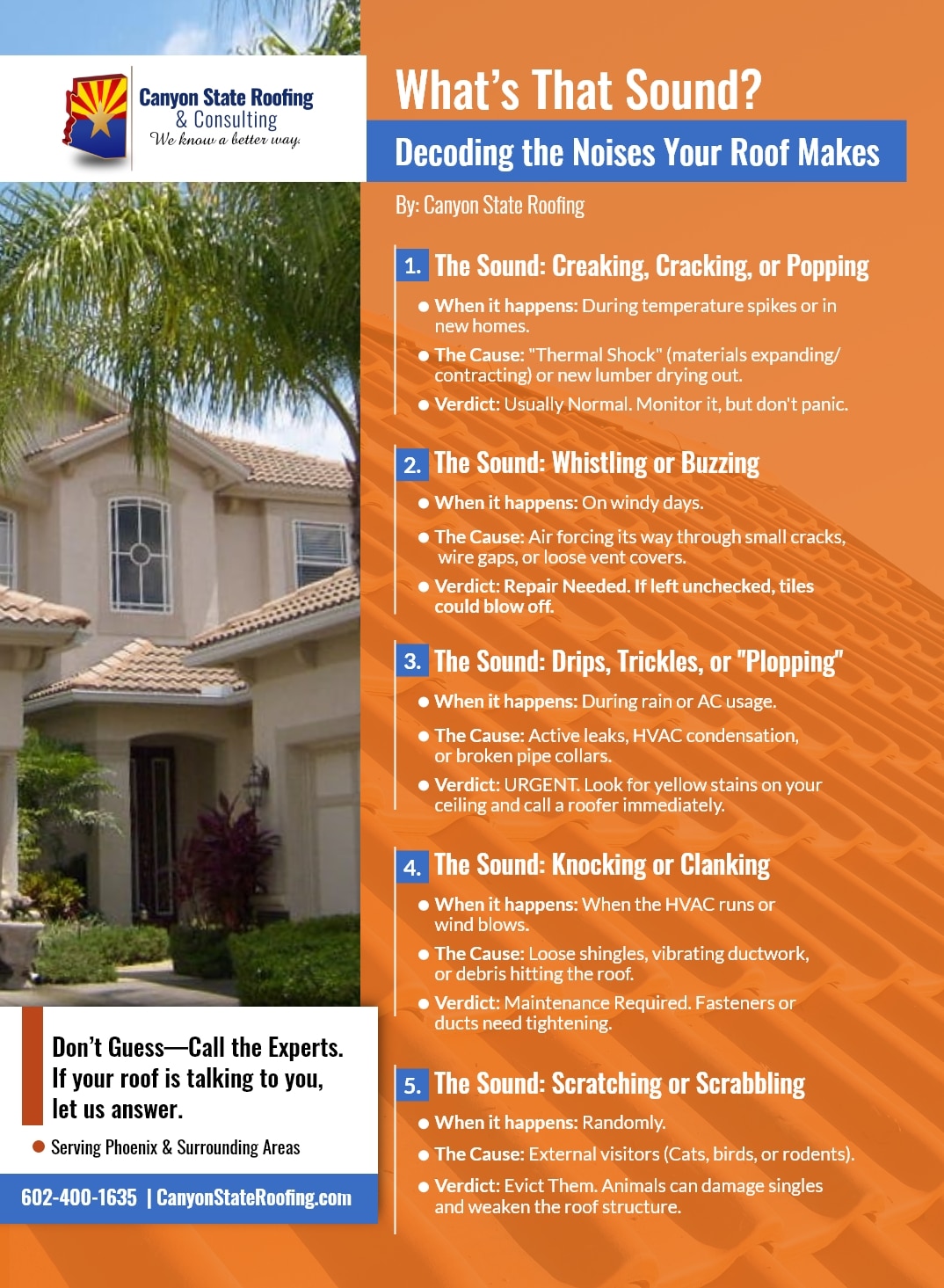
The Rapid Diagnostic: Identify Your Sound
Don’t have time to read the full breakdown? Find your noise in our “Symptom Chart” below.
| If You Hear… | And It Sounds Like… | The Likely Cause is… | Urgency Level |
| Popping / Banging | A pistol shot or heavy thud | Thermal Shock (Expansion/Contraction) | 🟢 Low (Normal physics) |
| Scratching / Running | Light feet, scurrying, or chewing | Pests (Roof Rats or Pigeons) | 🔴 High (Structural damage risk) |
| Flapping / Clapping | A rhythmic slap against wood | Wind Uplift (Loose Shingle/Underlayment) | 🟡 Medium (Fix before rain) |
| Hissing / Dripping | Water running or air escaping | HVAC Leak or Pipe Burst | 🚨 CRITICAL (Immediate Action) |
| Squeaking / Grinding | Metal-on-metal screeching | Rusted Turbine Vent (“Whirlybird”) | 🟢 Low (Maintenance needed) |
1. The “Pop,” “Bang,” or “Crack”
The Science of Thermal Shock & Differential Movement
The Symptom:
You are sitting in your living room around 9:00 PM. The house is quiet. Suddenly, you hear a loud CRACK or POP coming from the attic. It sounds alarming, almost like a structural beam snapping.
The Expert Diagnosis:
This is Thermal Shock, but here is why it happens specifically in Arizona.
Your roof is made of two different materials: the Wood Trusses (structure) and the Concrete/Clay Tiles (cover).
- The Physics: Wood and concrete expand at different rates. During a 115°F day, your attic heats up. At night, the wood trusses contract (shrink) faster than the heavy concrete tiles.
- The Noise: That loud “pop” is the sound of the wood slipping against the tile or the metal hangers shifting. It is a release of kinetic energy, known in engineering as stick-slip friction.
Is it Dangerous?
Generally, no. However, this constant movement can eventually crack the mortar caps (the cement) that hold your ridge tiles in place.
- The Canyon State Check: If you hear popping and see chunks of concrete on your patio, you need an inspection to reseal those caps before the monsoon season.
2. The “Scratch,” “Scamper,” or “Gnaw”
The Arizona Pest Problem (It’s Not Just “Animals”)
The Symptom:
You hear distinct movements—rolling marbles, light footsteps, or chewing.
The Expert Diagnosis:
In the Phoenix Valley, generic advice about “squirrels” is usually wrong. We deal with Roof Rats.
- The Entry Point: Roof rats don’t just “find” a hole; they make one. They target “Roof Returns” (where the roofline ends and turns back into the wall) and Eave Gaps. They can chew through soft lead pipe jacks and even plastic vents in one night.
Why You Need a Roofing Expert, Not Just an Exterminator:
An exterminator might set a trap, but they rarely repair the structural damage the rats caused to your underlayment.
“I called Canyon State Roofing to have my roof inspected after I noticed some issues with animals potentially getting under my roof… The final result fixed multiple issues with gutters that were attracting bird nests.”
— Chad Spence | [Link to Review]
The Canyon State Solution:
We identify the acoustic pathway. As noted in studies on rodent burrow-acoustics, once a pest establishes a route, they will return. We seal these “superhighways” with steel mesh and specialized closures.
3. The “Flap,” “Clatter,” or “Slap”
Wind Damage & Sealant Failure
The Symptom:
When the wind picks up, you hear a rhythmic tap-tap-tap or a louder clapping sound.
The Expert Diagnosis:
This is Wind Uplift, often caused by Sealant Oxidation.
- The Mechanism: Asphalt shingles have a strip of adhesive tar on the back. Over 10+ years of Arizona sun, this tar oxidizes and loses its grip.
- The “Crease” Risk: When a shingle flaps, it bends back and forth. This creates a permanent “crease” at the top. Once creased, the shingle is effectively broken and will eventually tear off.
Note on Turbines:
If the sound is a metallic “screech,” it’s likely a rusted turbine vent (“Whirlybird”). Our crew can quickly repair damage if “a roof turbine was blown off” or wears out.
DIY Safety Check: What You Can Do Right Now
Before you call us, you can do a safe ground-level inspection.
DO NOT CLIMB ON YOUR ROOF. (Walking on tile breaks more tiles). Instead, go into your yard with binoculars:
- Look for “Granules”: Check your downspout splash blocks. Do you see piles of black sand? That is the protective coating of your shingles washing away.
- Check the “Drip Edge”: Look at the metal edge of your roof. Is it pulled up?
- Look for “Smudge Marks”: Check your vents. Do you see dark, oily rub marks? That is a sign of frequent rodent traffic.
4. The “Drip” vs. The “Invisible Leak”
Why You Can’t Trust Your Ceiling
The Dangerous Myth:
Many homeowners believe: “If my ceiling is dry, my roof is fine.”
The Expert Reality:
This is false. Your attic insulation acts like a giant sponge. According to research on attic moisture dynamics, fiberglass insulation can absorb significant water weight from a slow leak (like an A/C pan overflow) before gravity forces a single drop through your drywall.
The “Forensic” Difference:
You need a roofer who looks deeper than the surface. We use forensic inspection techniques to find what others miss.
5. The “Trust” Factor
We Don’t Sell You What You Don’t Need
Sometimes, the noise you hear is minor—a loose cable or a simple maintenance issue. Unlike competitors who might use your anxiety to sell a full roof replacement, we believe in honest diagnostics.
“I contacted Canyon State and to my pleasant surprise was told that a complete redo was not needed but that instead recoating and repairing… was all that was needed.”
— Greg Rohall | [Link to Review]
“I was impressed that after inspection they said we could hold off on a new roof for a few years… Instead they recommended roof maintenance.”
— Kelsey Wharton | [Link to Review]
Summary: When Should I Call a Pro?
Your house is a system. When that system makes noise, it is telling you something has changed.
- If it pops at sunset: You are likely fine (Thermal Shock).
- If it scratches at 2 AM: You have a pest problem (Call us to seal the eaves).
- If it drips anytime: You have a leak problem (Call us immediately).
Do not guess. At Canyon State Roofing, we use the technology and experience proven by hundreds of 5-star reviews to find the truth.

Canyon State Roofing
4809 E Thistle Landing Dr #100
Phoenix, AZ 85044
Office: 602-400-1635
Email: [email protected]
Website: www.canyonstateroofs.com